Project Report on CCTV Cameras Solution
Objective:
- To give Security & Protection to the interested one.
- To activate 3rd eye where someone is unable to look over.
Pre-requisites
- Technical Team.
- Office.
- Marketing.
Introduction
- Closed-circuit television (CCTV), also known as video surveillance.
- It is the use of video cameras to transmit a signal to a specific place, on a limited set of monitors.
- It differs from broadcast television in that the signal is not openly transmitted, though it may employ point-to-point (P2P), point to-multipoint (P2MP), or mesh wired or wireless links.
- Though almost all video cameras fit this definition, the term is most often applied to those used for surveillance in areas that may need monitoring such as banks, stores, and other areas where security is needed.
- Though video telephony is seldom called ‘CCTV’ one exception is the use of video in distance education, where it is an important tool.
Advantages of CCTV
The CCTV surveillance system has brought in a revolution in protecting homes and other commercial spaces.With their varied uses and countless benefits, you can see them in almost all
places today. Few of CCTV camera benefits include:
- CCTV surveillance cameras provide enhanced security with utmost clarity and ease of access.
- Anyone can handle the CCTV surveillance cameras with ease if they have access to them.
- You can keep a track of production processes and other processes in industries and other production units.
- They are a must for every retail stores, boutique, super markets and other shopping areas.
- They prevent burglary by alarming you about the breach of security.
- The CCTV surveillance systems are not easily damaged by dust, and severe climatic conditions.
CCTV Surveillance Market Analysis
According to “India CCTV Camera Market Outlook, 2021”, the India CCTV Camera market is expected to grow with a CAGR of more than 26 % in the period from 2018 to 2025. Technology wise non-IP dominates the Indian market but in the coming years IP is expected to take the lead soon. Non -IP technology constitutes of analog and HD CCTV cameras. Analog is technology which is in a depleting stage and it share is expected to be taken by the IP technology and the HD type CCTV camera. Dome typed cameras are the most widely used cameras in any sectors. Commercial segment is the driver of the CCTV market in India with the increasing count of SOHO’s and SME’s. With the increasing security concerns, residential sector would also be one of the factors for the increasing market. As criminal activities are more in the northern region of India, North dominates the market in terms of revenue.
What is CCTV (Closed Circuit Television)?
- Video Recording Device.
Components used for CCTV Camera
Different types of components are used for assembling of CCTV Camera:
- Body
- PCB + IR Kit with lenses.
- 3 types of Screw
- Piles
- IP Cable
- IP Pin Connector.
Description of Equipment’s
As such no machinery is required for CCTV camera assembly unit, only some tools are required to combine the components of the CCTV camera & convert it into the finished products. Following equipments are required:
- CCTV Cable Stripper
- Cable Crimping tool
- Ethernet Crimper tool
- CCTV Camera tester etc.
- Other hand tools and equipments
This project is based on IP Camera. A growing branch in CCTV is internet protocol cameras (IP cameras). IP cameras use the Internet Protocol (IP) used by most Local Area Networks (LANs) to transmit video across data networks in digital form. IP can optionally be transmitted across the public internet, allowing users to view their cameras through any internet connection available through a computer or a phone, this is considered remote access.
Types of CCTV Camera & Uses
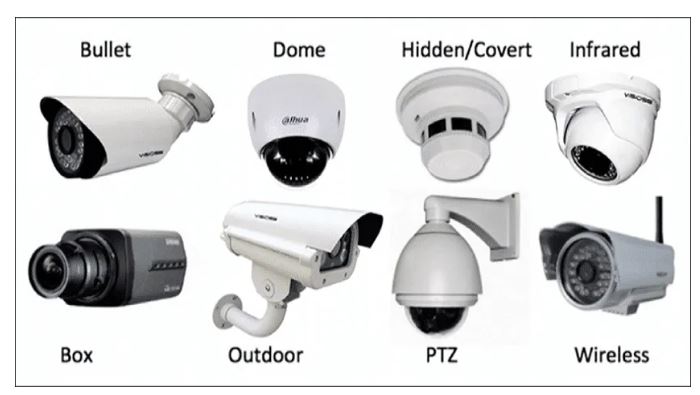
9 popular CCTV Cameras:
- Dome CCTV Cameras
- Bullet CCTV Cameras
- C-Mount CCTV Cameras
- PTZ Pan Tilt & Zoom Cameras
- Day/Night CCTV Cameras
- Infrared/night vision CCTV Cameras
- Network/IP CCTV Cameras
- Wireless CCTV Cameras
- High Definition (HD) CCTV Cameras
What are CCTV Cameras?
- CCTV abbreviation usually represents closed-circuit television and also is commonly referred to as Video Surveillance.
- The closed circuit means that broadcast are transmitted to closed number of monitors located into a CCTV room.
Types of CCTV Cameras
#1. Bullet CCTV Cameras
- Bullet CCTV cameras have an iconic design that is highly visible.
- The Most conventional CCTV cameras will be bullet CCTV and are instantly recognisable as being a CCTV security system.
- They are cylindrical in shape and are capable of observing long distances.
- Bullet cameras are most commonly placed outdoors so their casings are made resistant to water, dust and dirt.
- This design is highly suited for outdoor positioning
Top Pros of Bullet CCTV Camera
- Highly visible so acts as a deterrent to criminals
- Resistant to dirt in challenging environments
- Provides surveillance over long distances
- Casing also protects against glare and rain
Where to use
- Mostly used outside due to their nature and capabilities.
- Range of industries i.e. Manufacturing, Factories etc.
- They not only record good quality pictures but also send out a message to passers-by that your premises is under surveillance.
- The cameras can easily be mounted with a mounting bracket, and come fitted with either fixed or varifocal lenses depending on the requirements of its intended application.
#2. Dome CCTV Cameras
- Dome cameras are so-called because of the shape of the casing and are commonly used on public transport, as one example.
- The dome means that operators can point the camera in any direction without the subject being aware.
- One of the main Pro’s of a dome CCTV camera is its ability to rotate 360 degrees, allowing you to cover all angles of your premises.
- In addition, their design makes them an ideal choice for indoor surveillance, as they can be mounted on a ceiling to monitor a wide area without being too noticeable.
- These cameras are often used in retail stores, banks, and other public spaces where surveillance is needed but a discreet appearance is desired.
Benefits of Dome CCTV Cameras
- Suitable for indoor and outdoor use
- Vandal resistant dome means it is harder to interfere with the camera
- 360-degree rotation of the camera so you can cover all angles
Where to use
- A dome CCTV camera is best for hospitality and corporate settings.
- It can be used in shops, hotels, casinos, restaurants, etc., because of its design and ability to cover a wider angle.
#3. Infrared/night vision CCTV Cameras
- These cameras boast infrared technology, which allows them to record video images even when there’s no light.
- These cameras are also suitable in foggy conditions.
- With Night vision capabilities, CCTV cameras are specifically designed to capture footage in pitch-black conditions.
Benefits of Infrared/Night vision Cameras
- Infrared LEDs allow clear recording even in pitch black environments
- An infrared cut filter activates in the daytime for clear images in lighter conditions
- Can capture images even in the presence of fog, dust or smoke
- Records colour imagery in the daytime and black and white at night
Where to use
- These cameras are best suited for places that require round-the-clock security, such as banks, manufacturing plants, etc.
- There are various CCTV camera types suited to outside use but the extra sensitive imaging of both day and night imaging modes makes this one camera type unique.
#4. Day/night CCTV Cameras
- Designed to operate throughout the day, irrespective of the ‘lighting’ factor.
- Even if it’s day or night, a day/night camera will record clear footage. They contain extra sensitive imaging chips, which help them to record clear videos that are not impacted by the lighting conditions.
- Overall, day and night CCTV cameras are an effective solution for businesses and other organizations that need to monitor their premises around the clock, regardless of lighting conditions.
Benefits of Day/Night CCTV Cameras
- capacity to capture crystal-clear video in dim lighting.
- Glare, direct sunlight, reflections, and other problematic lighting situations don’t hinder their ability to perform well.
Where to us
- They are also frequently used in indoor environments like warehouses, factories, and office buildings where the lighting may be poor or unbalanced.
#5. Pan Tilt & Zoom (PTZ) Cameras
- These cameras have the ability to pan (move horizontally), tilt (move vertically), and zoom in and out.
- This allows them to cover a wider area and follow movement more effectively.
- Your security team can have complete control over what is recorded.
- At the touch of a button, the camera lens can pan left and right, tilt up and down or zoom in and out.
Benefits of PTZ Cameras
- Optical zoom on these cameras means you can focus closely in on subjects
- Pan and tilt feature provides 360 degree field of vision
- Image resolution is usually impeccable so facial features can be distinguished
- Security team have full control of recording and can react to live situations.
Where to us
- These cameras are particularly useful in large retail environments and for businesses that need to protect specific valuable objects.
#6. C-Mount CCTV Cameras
- C-Mount CCTV cameras are a type of security camera that are equipped with detachable lenses, allowing the field of vision to be easily adjusted.
- They are ideal option for those who may wish to adapt the field of vision.
- Due to their functions, C-mount CCTV cameras are suitable for outdoor settings.
- They have a rugged casing and weatherproof housing that protects cameras from cold environments and other environmental elements.
Benefits of C-Mount Cameras
- Special lenses can be fitted to the camera to extend its range.
- Great visibility that deters criminals
- Rugged casing can be added to protect the camera in harsh environments
- Weatherproof housing makes it ideal for outdoor use
where to use
- C-mount CCTV cameras are mostly used in logistics and utility industries.
- Their ability to withstand extreme temperatures also makes them suitable for food and manufacturing industries.
#7. Network/IP CCTV Cameras
- They’re connected via the internet working with IP Addressing sharing footages across the internet. So, even if you are not on the office premises or located anywhere in the world, you can view the footage easily, provided you have a stable internet connection.
- Video footage is typically stored on NVRs (Network Video Recorders) or in the cloud for future access.
Benefits of IP CCTV Cameras
- These are low-maintenance cameras
- Easy to setup
- Can be remotely access
where to use
- IP CCTV cameras prove to be quite useful in corporate entities where owners frequently want to keep an eye on their business premises.
- This can be done remotely via mobile apps or computers.
#8. Wireless CCTV Cameras
- As the name suggest, they do not require any cabling.
- These cameras transmit footage over the internet, allowing for remote viewing. hey also make the appearance of the camera much tidier, which may be an important factor in some settings.
- They are easy to install since there are no hassles of wiring.
- They also have a discreet appearance; therefore, they can blend seamlessly with the interior
Benefits of Wireless CCTV Cameras
- Easier to install than your average CCTV system
- Discreet and tidy appearance and a less obtrusive fitting
- Images transmitted over the internet so can be viewed anywhere
- Secure storage and easy access of archive footage
Where to use
- Wireless CCTV cameras are a great security option.
- Their discreet appearance helps them to blend into the interior.
- They’re great to use if you’re looking for a tidy workspace and descrete environment
#9. High Defination (HD) CCTV Cameras
- HD CCTV cameras are known for their splendid, high-clarity images.
- You can even get 4k resolutions from these cameras, which means there will never be a chance of distorted or grainy images.
- If you want extra clarity, you can use the zoom function of these cameras.
Key Pros of HD Cameras
- High definition Images bringing about clarity
- Available on most CCTV models such as domes and bullets
- Crystal clear imagery ensure they’re great source of crime scene evidence
Where to use
- HD CCTV cameras are considered the best choice for premises where there is a high risk of theft.
- You can see them in banks, casinos and other places that require visitor identification.
Factors to Consider while sourcing for CCTV Systems
High Definition Camera
mostly used in Niche Markets, such as bank, areas of maximum security. They offer the feature that enables the controller to zoom on a specific target. This ability to zoom to clarity makes it a great feature among the various types of CCTV cameras.
Day or Night CCTV Camera
These Cameras are advantageous in that they can capture clear images in varying light conditions. They best suited for outdoor surveillance and where there is a need for a 24/7 Surveillance. Most residential apartments embrace the use of such cameras
DVR & NVR (Digital & Network Video recorder)
These are not cameras by themselves but are crucial components of CCTV solution. They provide the ability to fully Record the CCTV footage and save them on storage facilities that making it easy to fully review the daily CCTV footage of each Camera.
Coverage
you will have to do a site survey to ensure the most vulnerable parts of your prized asset. With this information you understand the size of the perimeter to set for your organization CCTV Camera needs
Power backup solution for your cameras
The constant power supply would ensure incessant surveillance. Thus make sure you have both constant power supply and a reliable power backup in case of power cuts to ensure security at all times
Permission
Depending on where you will be doing a CCTV installation, you may need to get official permission from relevant authorities also from your neighbor surrounding just not interfere with their privacy incase your cameras covers some part of their premises.
The question may arise; so which is the best type of camera to install on your premise? The true answer to this is that there is no single best type of camera to deploy.
The various cameras are designed to best work on various needs and requirement than the other i.e. some cameras are best suited for different locations within the premises such as outside or inside the premise.